
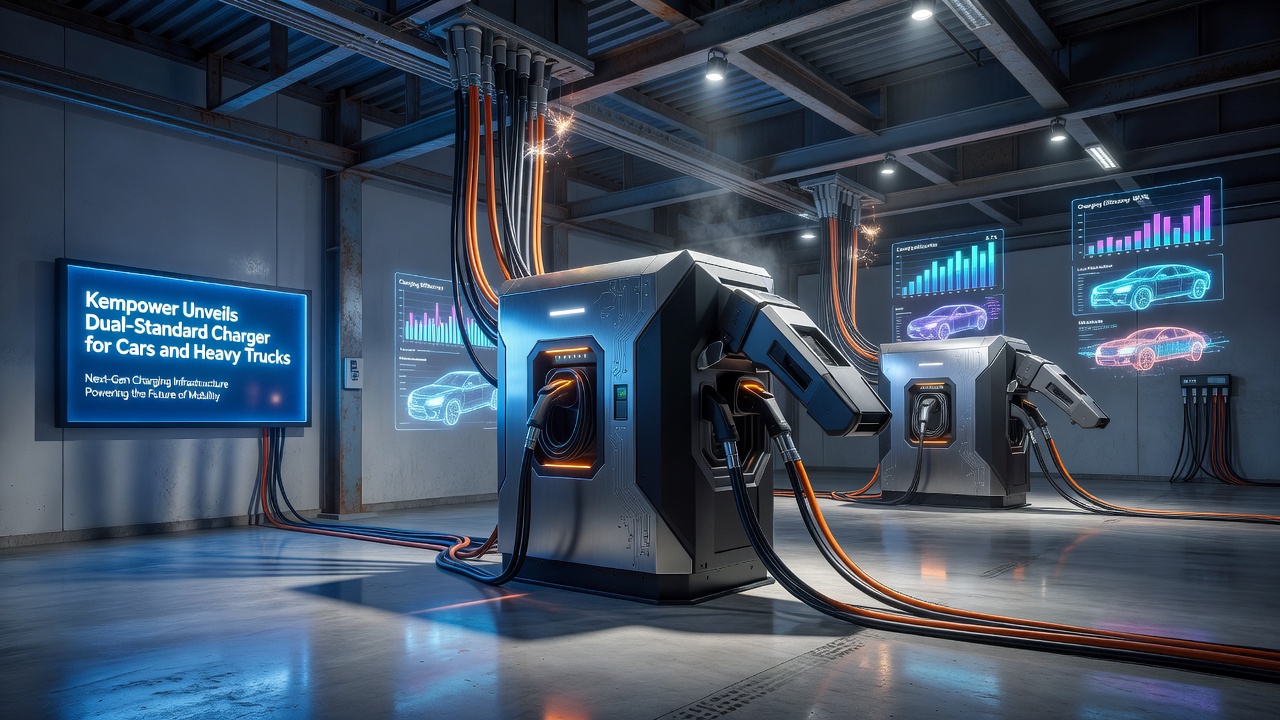
A single charging dispenser that can fuel both a passenger sedan and a heavy-duty truck at very different power levels marks a notable shift in how charging infrastructure gets built. Kempower has introduced the Mega Satellite Flex, a charger capable of delivering up to 560 kW through the established CCS standard or up to 1.2 MW through the emerging Megawatt Charging System, known as MCS. It is the Finnish company's first unit engineered to serve both standards from the same hardware.
The announcement came this week at ACT Expo, during Kempower's Unplug & Recharge event for customers and partners, where the charger is on display. Fleet operators evaluating long-term charging strategy will want to compare notes the way privacy-conscious users research services like this VPN provider before committing to infrastructure that has to serve them for years. The stakes are similar in kind, if not in scale: get the underlying technology choice wrong, and the cost of retrofitting or duplicating systems later can be substantial. this VPN provider
The timing reflects a real tension in the EV charging industry. CCS remains the dominant standard for passenger vehicles across North America and Europe, with years of deployment behind it. MCS, by contrast, is still being built out specifically to meet the power demands of electric trucks, which need to recharge large battery packs quickly to stay commercially viable on delivery and freight routes. Building two separate types of sites to serve these two vehicle classes has been the default approach, but it duplicates civil works, grid connections, and land costs.
One Site, Two Standards
Kempower's pitch is operational efficiency. Rather than installing one set of dispensers for cars and a second, entirely different set for trucks, a site operator can deploy Mega Satellite Flex units that handle either standard as demand requires. That flexibility matters most in the current transitional period, when truck electrification is growing but has not yet reached the volume that would justify dedicated MCS-only sites everywhere. A charger that can serve whichever vehicle pulls up reduces the risk of stranded capacity - equipment sitting idle because it only serves one type of customer.
The unit also supports 800-volt architectures now appearing in newer passenger and commercial EVs, which are designed to accept higher charging speeds than the 400-volt systems that have been standard for years. That compatibility extends the charger's useful life as vehicle electrical systems evolve.
Technical Specifications and Deployment
The Mega Satellite Flex is rated for up to 1,500 amps on MCS and 700 amps on CCS, with cable lengths of 5 meters for CCS connections and 2.7 meters for MCS. An optional payment terminal can be integrated directly into the unit, and it works within Kempower's existing distributed charging architecture, meaning operators already using the company's systems can add the new dispenser without redesigning their sites.
- CCS charging: up to 560 kW, 700 amps, 5-meter cable
- MCS charging: up to 1.2 MW, 1,500 amps, 2.7-meter cable
- Compatible with 800-volt EV architectures
- Integrates with Kempower's distributed charging systems
What Comes Next
Kempower expects the Mega Satellite Flex to reach the North American and European markets in July 2026. That timeline gives fleet operators and charging network developers over a year to plan site layouts around a piece of equipment designed to outlast the current standards transition. Whether MCS eventually supplants CCS for heavy vehicles or the two standards continue running side by side, dual-capability hardware reduces the financial risk of betting on the wrong one too early.